


So You Want to Play Tennis? Welcome to the Madness

So, You Want to Learn How to Play Tennis...
AWESOME!
Congrats on picking the most beautiful sport in the world.
At first glance, tennis looks pretty simple. You have a racket, a ball, a net and a rectangular court. Hit the ball over the net and inside the lines.
How hard could that possibly be?
Well... welcome to tennis.
I consider tennis one of the hardest sports in the world to truly learn, and that's also one of the reasons I love it so much.
Tennis combines hand-eye coordination, technique, footwork, speed, endurance, strength, balance and decision-making—and somehow you're supposed to put all of those things together while a fuzzy yellow ball is flying at you.
The good news?
Learning how to do all of that is incredibly fun and challenging.
Side note: There are plenty of people out there who think pickleball will eventually overtake tennis. Maybe it will become more popular. Who knows?
But I believe tennis will ALWAYS be part of our civilization for the very reason that frustrates so many people when they first pick up a racket: It's downright hard.
You don't master tennis in an afternoon. You don't figure it out in a weekend. In fact, you can play this sport for 50 years and still walk off the court thinking, What in the world happened to my forehand today?
And that's part of the beauty of it.
Tennis constantly gives you something to chase. A cleaner forehand. A better serve. Faster feet. More consistency. Winning your first match. Beating somebody you've never beaten before.
The challenge never completely disappears.
But neither does the reward.
First, We Have to Learn How to Hit the Ball

Tennis is a hand-eye coordination sport, so the first challenge is learning how to consistently make clean contact with the ball.
But we're not just trying to smack it over the net.
Technique matters.
A beginner needs to learn how to hold the racket correctly, where the contact point should be, how the racket travels through the ball and how the body works together during the swing.
For ground strokes, I teach a semi-Eastern style forehand grip and a straight-arm forehand. On the backhand side, I teach the two-handed backhand along with a one-handed slice. At the net, we use the continental grip for volleys, and that grip also becomes extremely important as we develop the serve.
And then things start getting interesting.
Because there isn't just one forehand.
You might get a high forehand, low forehand, wide forehand or short forehand. The ball might arrive with topspin, slice or very little spin at all.
The same thing happens at the net. You can hit a deep volley, angle volley, high volley or drop volley.
That's tennis.

Just when you think you've learned a shot, the sport says, "Great. Now let's give you that same ball while you're running."
Your Feet Have a Very Important Job
Beginning players naturally think tennis is mostly about what they do with their hands.
It's not...Your feet are enormously important.
You have to learn to move forward, backward and sideways. You need small adjustment steps to position yourself around the ball. After hitting, you have to recover and prepare for the next shot.
Eventually, good footwork becomes almost automatic.
When I coach beginners, I don't want them just standing there while I feed balls directly to their racket. We may start that way while learning technique, but eventually we're going to move.
After all, the ball isn't going to politely find you during a match. :)
Welcome to the Tennis Fitness Program
This is another reason tennis is such a fantastic sport.
You're going to get fit.
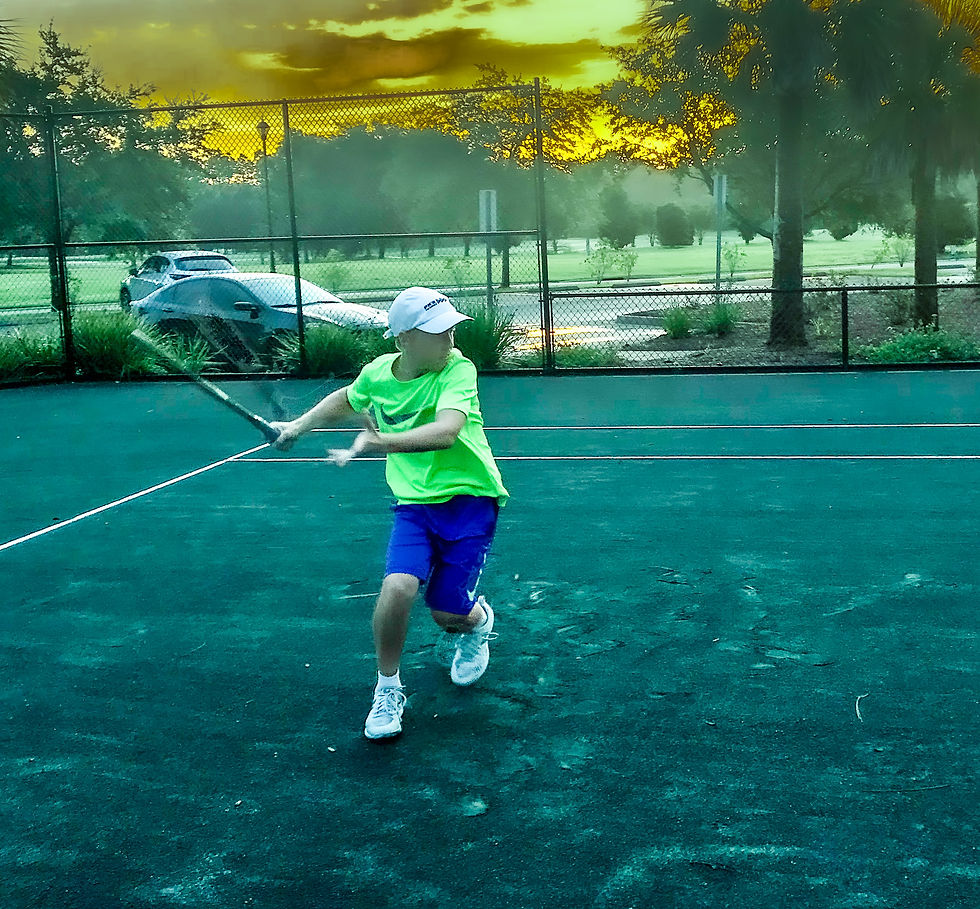
A tennis player needs an unusual combination of endurance and explosive speed. I like to think of it as having some of the engine of a 10K runner while still being able to explode into a three- or four-second sprint.
You accelerate, stop, change direction, accelerate again and recover between points.
For conditioning, I like variety. I'm a big fan of treadmill work and uphill sprints. I also love cycling because it's low impact while developing the cardiovascular system, glutes and quads.
Then we add strength training.
We're not necessarily trying to turn a tennis player into a bodybuilder. We're trying to create a stronger, faster and more durable athlete.
The Rainbow Is Your Friend
One of the first concepts I teach beginners is hitting with shape.
Imagine the flight of your ground stroke creating a rainbow over the net.
Why?

Think about how you can miss a tennis ball. You can hit it into the net, long or wide.
If I can teach you to generate topspin and safely create height over the net, we're already working toward eliminating one of those problems.
Topspin allows us to swing through the ball, create height and then help bring the ball back down into the court.
That's when tennis starts getting really fun.
Instead of thinking, Please go over the net, you start thinking, I want that ball five feet over the net and deep into that corner.
Now you're not just hitting.
You're playing tennis.
"Coach, I Want My Kid to Get a Scholarship"
I've heard this one plenty of times.
A parent brings me a young player and says, "I want my kid to get a college scholarship."
Great. Let's get to work.
But parents need to understand the size of that journey.
Developing a legitimate Division I-level tennis player can mean five to ten years of consistent development. It requires regular training, physical development, tournament competition and match play throughout the year.
You cannot microwave a tennis player.

Competition is especially important because matches expose weaknesses that practice doesn't always reveal.
Can you hit that beautiful forehand at 30-all?
Can you hit a second serve when you're nervous?
Can you solve a problem when your opponent figures out what you don't like?
That's another layer of tennis: learning how to compete.
What Happens at Your First Lesson?
If you've never touched a tennis racket before, that's perfectly fine.
I don't expect you to know anything.
We'll start with the basics: how to hold the racket, how to position your body and how to make clean contact. We'll work on the forehand and backhand and begin introducing basic footwork.
Most importantly, you're going to hit tennis balls.

I'm a believer in explaining technique, but we're not going to spend your entire lesson standing around talking about it.
I want you learning by doing.
Hit. Move. Adjust. Hit again.
Miss one?
Good.
Grab another ball.
That's how we learn.
As you improve, we'll add movement, topspin, direction, serves, volleys, overheads and eventually point play.
Nobody masters tennis in their first lesson—or their first hundred lessons.
That's the beauty of the sport.
One day, success means hitting ten balls over the net. Before long, you're trying to create more topspin, attack a short ball, finish an angle volley or construct a point.
Tennis has a way of continually moving the goalposts. Just when one part of the game begins to feel comfortable, another presents itself. There is always another shot to learn, another weakness to address and another level to reach.
Somewhere along the way, though, something changes. You stop thinking quite so much about simply getting the ball over the net. You begin thinking about what you want to do with it.
That's an important moment. You're no longer just learning how to hit a tennis ball. You're learning how to play tennis.
And that's when the game really gets interesting.
Coach Paulie P.
Title Town Tennis


Comments