


Raising a High-Level Player While Raising a Special Needs Child

In the world of high-performance tennis, people often talk about perfect environments.
Perfect training schedules. Perfect weather. Perfect routines. Perfect structure.
But real life rarely works that way.
And in our household, it definitely doesn’t.
Because while I am raising a high-level developing tennis player in Max,I am also raising my daughter Parker — who has special needs. Parker Kate was born with an extremely rare condition called Lissencephaly. The term "liss" means, "smooth brain".
And that reality has shaped not only my parenting, but my entire coaching philosophy.
High performance training is demanding.
It requires time. Energy. Planning. Consistency. Mental focus.
But parenting a special needs child requires something even deeper:
Presence.
Patience .Adaptability. Perspective.
There are days where training has to be adjusted. Days where the schedule changes. Days where life simply takes priority over the court.
And that is not a weakness.
That is real life.
What many people don’t see behind the scenes is that Parker is not separate from the journey.
She is part of it.
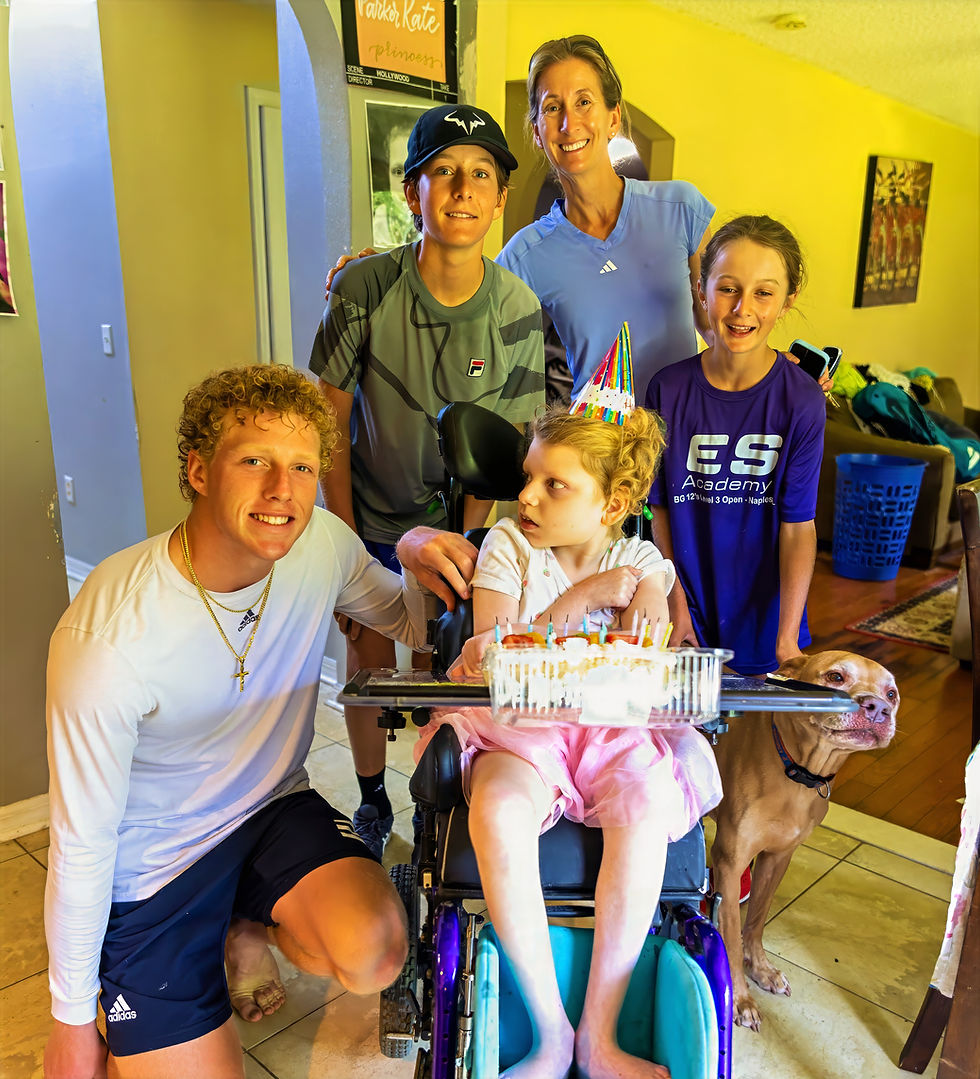
She has been present during practices, matches, photo days, and long training weeks. She has been there during the grind, not just the victories.
And in many ways, she has taught lessons that no tennis drill ever could.
Patience under pressure. Emotional awareness. Gratitude for the small wins. Perspective beyond rankings and results.
Developing a high-level player like Max is not just about ball counts and drills.
Yes, we focus on:
Purpose before the shot
Intent in training
Box drills and directional clarity
Strength, movement, and mental discipline
But the deeper layer of development happens off the court.
Watching his sister. Learning empathy. Understanding that life is bigger than tennis.
That creates a different kind of athlete.
A more grounded one. A more resilient one. A more mature competitor.
Our philosophy at Title Town Tennis has quietly evolved because of this life dynamic.
Family-first does not mean low standards. It means meaningful standards.
It means when we train, we train with intention. Not just volume. Not just noise. Not just random hitting.
Because when your life requires balance, your training must require purpose.

There is also a truth that many high-performance environments ignore:
There is no such thing as a perfect developmental path.
Some families travel nonstop. Some train six hours a day. Some have full teams and perfect systems.
And some families are balancing real-life responsibilities, health, emotions, and unique family needs.
Yet growth still happens.
In fact, sometimes it happens in a deeper way.
Raising Max alongside Parker has reminded me constantly that legacy is not just built through trophies or rankings.
It is built through character. Through resilience. Through how you show up when life is not convenient.
And honestly, that mindset has made our training stronger, not weaker.

More intentional. More focused. More meaningful.
At the end of the day, tennis is a part of our life.
But it is not the whole story.
The real story is a family navigating high performance, real challenges, and real love — all at the same time.
And if there is one thing I have learned through this journey, it is this:
You do not need a perfect life to develop a high-level player.
You need purpose. Perspective. And a heart strong enough to balance both ambition and compassion.
That is the true foundation of Title Town.
– Coach Pauly P
Title Town Tennis 🎾


Comments